
In this article
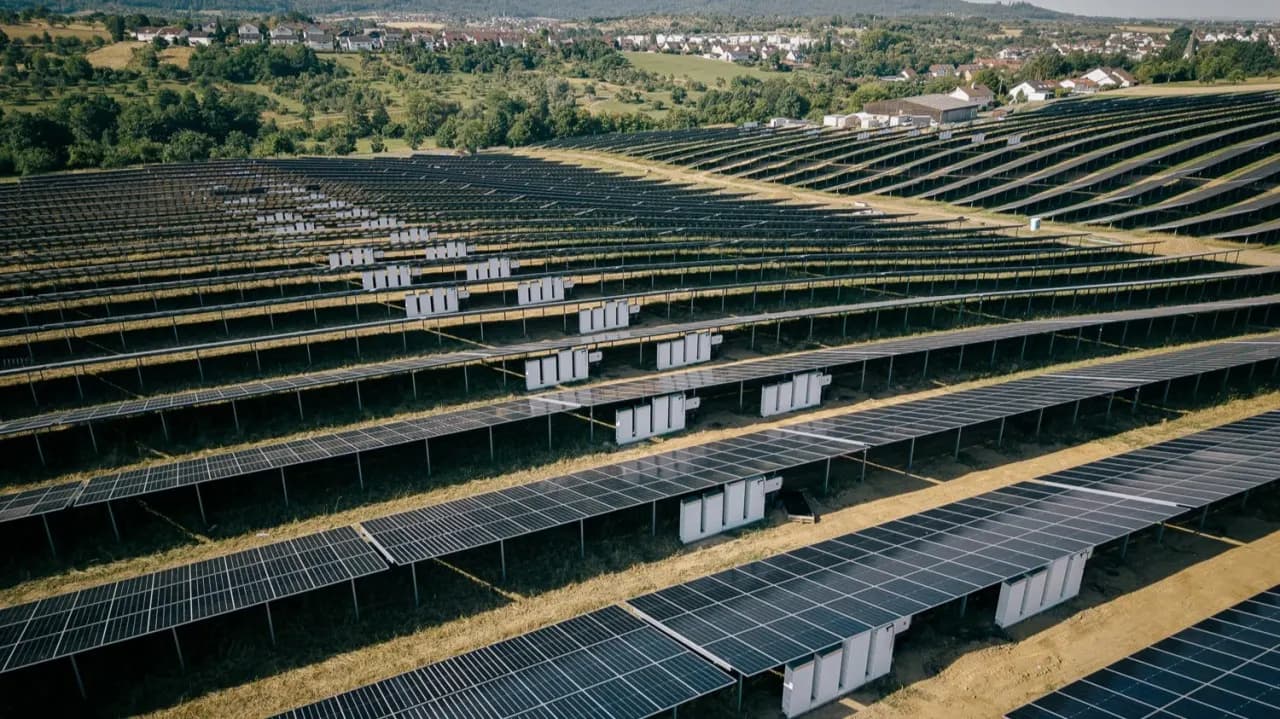
On 11 September Sigenergy announced a utility-scale project at Solarpark Pfaffenklinge in Weissach im Tal, Baden-Württemberg: 11.6MWp of solar, 20MWh of battery storage, all of it sitting behind an 8.8MVA grid connection. The claim attached to it is that DC coupling lets the plant generate at full capacity without curtailment, because anything above the connection limit goes onto the DC bus instead of through the meter, and gets dispatched later when grid capacity and wholesale prices allow.
The engineering is sound and the ratio is worth looking at. Generation capacity sits about 1.3 times the connection limit. That is a plant deliberately built larger than the wire it is plugged into.
Now put that next to a Western Australian house. Under the SWIS connection rules that took effect on 1 May 2026, a home or small business on a standard connection can install up to 30kVA of aggregate inverter capacity, counting solar, battery and anything else inverter-based on the site. Export is then governed by one of two pathways. Either the system is communications-capable and remotely controllable by the retailer, which opens the flexible export pathway, or it is export-limited to a fixed 1.5kW.
Take the second pathway with a 10kW array and the ratio is closer to 20:1, not 1.3:1. The German plant's problem, at house scale, looks mild by comparison.
Deferred export and fixed limits
Read the Sigenergy framing carefully and the mechanism is deferred export. Store the surplus on the DC bus, wait, then push it to the grid when capacity frees up and the price is worth having. It works in a European market where the connection limit is a throughput constraint that varies through the day, and where negative price events on exchanges like EPEX SPOT make the timing itself valuable.
A WA fixed export limit does not behave that way. The 1.5kW cap is a hard ceiling on what leaves the property, and it is the same ceiling at 2pm and at 8pm. There is no later window in which the network invites the stored energy out. Nothing is queued up waiting for permission.
So if a supplier explains DC coupling to you in WA using the language of deferred export, they have imported a story that fits a different grid. Ask them what happens to the stored energy at 6pm on the 1.5kW pathway, and the honest answer is that it goes into your own house or nowhere.
Self-consumption in WA
It is self-consumption, and the arithmetic is not close.
Synergy's Distributed Energy Buyback Scheme pays 10c/kWh for exports between 3pm and 9pm, and 2c/kWh outside that window, capped at the first 50kWh exported each day. Your surplus generation mostly happens outside that window, so most of it is a 2c product. Synergy's Home Plan A1 residential tariff is 33.26c/kWh from 1 July 2026.
A kilowatt-hour you keep is worth roughly 16 times a kilowatt-hour you export off-peak. That gap, not the export limit, is what makes storage worth having behind a small connection in WA. Both figures are current as at the 1 July 2026 reset and are subject to change, so check them before they go in a quote.
Which reframes the whole question. In Germany the battery is a timing instrument. In WA it is a way of making a large array useful when the grid will barely accept anything from it.
DC-coupling benefits and limits
Three things are better about DC-coupled storage in this context.
The conversion path is shorter. Surplus solar goes to the battery as DC without a round trip out to AC and back. Sigenergy's own claim for the German plant is about 3.7% higher conversion efficiency against an AC-coupled equivalent. Treat that as a vendor figure measured at utility scale, with 80 hybrid inverters at 100kW each. At house scale the margin is smaller and it is not the reason to choose a system.
Clipping headroom is real, and more relevant. If your array is oversized against the inverter, a DC-coupled battery can take generation that the inverter would otherwise have to throw away at the top of a clear day. On the 30kVA aggregate allowance a WA site now has room for arrays that would previously have been out of the question, and the clipped energy on those arrays is not trivial.
Fewer boxes on the wall, fewer things to commission. Anyone who has done a battery retrofit knows the second-inverter arrangement adds cable runs, isolation points and another item to bring into the AS/NZS 4777.2:2020 commissioning record. Less hardware is not a marketing point. It is a shorter list of things that can be installed wrong.
What DC coupling does not do is decide your outcome. That is decided upstream by which export pathway you are on.
Settle the export pathway
If you want the flexible export pathway, the system has to be communications-capable and speak CSIP-AUS through Synergy, and it has to hold Emergency Solar Management capability, which has been mandatory on new and upgraded SWIS systems since 14 February 2022. Not every product on the market does this well in practice, and a product page saying "CSIP-AUS compatible" is not the same as a commissioned, working connection. We have been through enough of these to say that plainly.
If you take the 1.5kW fixed-export pathway instead, you have opted out of ever selling meaningful energy to the grid, and you should size the battery to your evening load rather than to your generation. A larger battery does not help you if there is nothing to do with the extra capacity by morning.
Here is the opinion that will cost us a sale occasionally. Do not buy a battery because its data sheet says DC-coupled. On a normal Perth house the coupling topology is a second-order decision, worth a few percent, and it is routinely oversold. The first-order decisions are your export pathway, whether the array is sized to a load you have, and who does the install. A well-commissioned AC-coupled retrofit on the flexible export pathway will beat a poorly configured DC-coupled system every time, and we have seen both.
Where the topology does swing the decision is a new build with a deliberately oversized array, or a site where the array is going in and the battery is going in together and there is no existing inverter worth keeping. Those are the jobs where it is worth paying for.
If you are working through a system for a WA site and want the connection pathway mapped before equipment is chosen, that is a conversation worth having early rather than after the order is placed.